
Read the White County Owner-of-Record Card
The county-linked Beacon property card is the working record. It shows the owner of record exactly as the White County Assessor lists the name now, and you should read it beside the parcel number, situs, and card date so the entry stays tied to the right land.
| Owner/current owner | The person, people, trust, estate, or entity carried on the assessment roll |
|---|---|
| Mailing address | Where assessment or tax correspondence is directed |
| Situs address | The physical location used to match the property |
| Parcel and tax IDs | The identifiers used to keep the same land in view across systems |
| Legal description | The documentary description used to match a deed |
| Assessment/history fields | Dated administrative context, not a guaranteed ownership-update schedule |
The tax roll does not prove who lives there. Occupancy is a separate question. A mailing address often points elsewhere, because notices go to an out-of-county owner, a trust, an entity, or a second delivery address, while the situs stays tied to the land itself.
Check the Exact Current-Owner Name in Beacon
Start with a situs address search, then copy the owner string exactly. A surname-only search can rescue a failed address lookup. But inspect every returned address, since similar names and joint holdings are common. Beacon also accepts parcel and tax-ID searches. If both identifiers appear, copy both rather than treating them as interchangeable.
White County records often list several owners. The name may be a trust, an estate, or an LLC. Keep punctuation, initials, and ownership phrases intact before searching the Recorder. Those details can separate the true current owner from a similarly named party.
How Current Is White County's Owner Record?
White County publishes no set closing-to-roll delay. The Assessor states no refresh interval. Trust the records instead of a guess. The Assessor name is an administrative snapshot, while the recording date and instrument on the newest deed document the legal event itself. If the two disagree after a closing, keep both dates and recheck the tax roll later.
Recent sale. A newly recorded deed can be more current than the Beacon owner field. Confirm that its legal description matches the parcel before treating the grantee as the current recorded owner.
The Treasurer adds another dated administrative view. Its taxpayer or name field is not a substitute for the deed. Treat it as a cross-check. It can flag a different name or an older account on the same parcel number. Any difference should be resolved through the Assessor and Recorder. Those are the two offices whose records control. Note which office showed each name when comparing them.
Verify the Current White County Owner
The Recorder is the office to use here, and nothing more is needed. A full chain-of-title reconstruction belongs on the former-owner page instead.
- Open the Beacon card and capture owner, situs, mailing, parcel IDs, and legal description.
- Search the White County Recorder through Laredo for the newest plausible conveyance.
- Read the deed image and compare its grantee and legal description to the card.
- Record the instrument number and recording date; do not infer a county roll-update date.
- For an LLC, compare the exact entity name with Indiana INBiz without assuming its registered agent owns the parcel.
- Owner of record
- The party named in the particular official record being consulted.
- Assessment roll
- The Assessor's administrative record of parcels, owners, characteristics, and values.
- Situs and mailing
- The property's physical location and the separate address used for correspondence.
- Recording lag
- The possible interval between a conveyance and another system's update; White County publishes no typical interval.
Use the White County Recorder as the Date Check
The Recorder's Laredo index covers deeds and images from November 1834 to the present. That reach is far more than a current-owner check requires. Focus on the newest deed. Its legal description should match the subject land. The official Recorder page is linked below for live access information. Open the current source page to reach it directly.
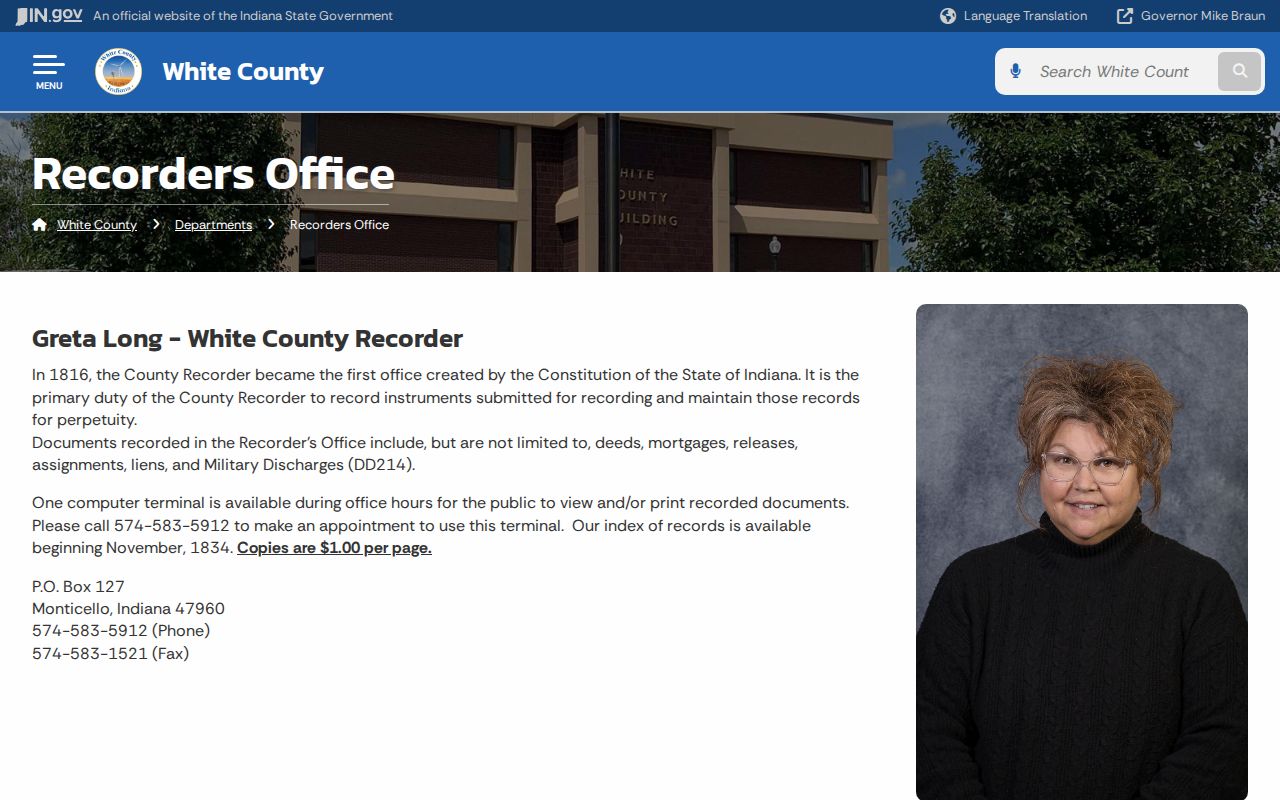
The page names the custodian and the access routes. It does not name an owner itself. The matching deed entry and image supply the grantee, instrument type, recording date, and legal description that verification takes.
Interpret Entity and Shared Ownership Names
One owner field can hold a lot of names. Spouses, siblings, and trusts show up in a single current-owner string. So do fractional interests, estates, and businesses. The Recorder prints whatever the legal record says. Report that language plainly. Resist the urge to turn it into a legal conclusion it cannot support.
Labels mislead in both directions. A trustee may sign only in a representative capacity. A registered agent may exist just to accept service for a business. Neither title, standing alone, proves that the person actually owns the land. An estate still appears on the White County tax roll at times. Set the newest Recorder instrument beside any probate record held by the White County Clerk before drawing conclusions. Where several people are listed, the deed itself controls. An abbreviated tax-list display cannot substitute for the instrument that sets the terms of ownership. Interpreting a fractional or contested interest may call for legal advice from a qualified attorney.
Check for a Recent White County Split or Combination
Splits and combinations deserve special care. The White County Treasurer warns that parcels split or combined within the last two years may need a last-name search to surface every bill. Treat that warning as a reconciliation clue. Compare predecessor and successor identifiers, addresses, districts, and legal descriptions. The taxpayer field is not a title-owner field.
A recent split can leave a saved parcel number looking stale. The owner name may still pull up related accounts. The Recorder and Auditor hold the transfer and plat records that explain what happened. Keep each resulting parcel distinct. Merging nearby results into one ownership claim invites error.
Enter the long identifier exactly as displayed. A White County tax identifier contains leading digits, hyphens, and a decimal segment. The county publishes no legend explaining the code. The format works as a matching key only. Do not use it to guess township boundaries or ownership. Beacon may list a separate parcel ID and tax ID. Record both in the current-owner notes.
Access White County Current-Owner Records
Beacon holds the online property record card. If that portal fails you, the Assessor can still help. The Assessor will provide an existing card by phone, email, or an in-person visit. Laredo works on an account basis. The Recorder keeps one public terminal, available by appointment, and takes questions by phone or at the counter. Recorded copies run $1 per page. Whatever route you choose, bring the parcel number. Bring the exact party name, the legal description, and an approximate recording date too.
Some administrative records fall outside the standard indexes. Indiana's Access to Public Records Act still opens a request route, though exemptions apply. The office does not have to build a new ownership analysis for you. For earlier owners, the historical library channels are the better fit. They cannot replace the present tax roll or the newest deed, though.
Four offices share one address: 110 N Main Street in Monticello. The Assessor, Recorder, Treasurer, and Surveyor all sit there. Room numbers and hours differ, so confirm the right office page before you drive over. The Treasurer can walk you through a tax account and the taxpayer display. Its list exists for tax administration alone. The Auditor handles transfer and plat administration. None of these replaces reading the newest recorded conveyance when ownership is genuinely disputed.
Keep any request narrow. Name the parcel, state the existing record you want, and give a useful date range. A quick phone call or email can confirm the card or instrument exists before you travel. Mail works too, if the custodian agrees to send copies. Need something official? Ask the maintaining office what certification it can provide. Do not print a portal screen and call it certified.
The Assessor occupies the first floor of the White County Government Center. It keeps weekday hours of 8 a.m. to 4 p.m. Its office number is 574-583-1522. Call the Recorder at 574-583-5912 ahead of any visit, since the public terminal runs by appointment only. Before ordering, confirm certification, postage, and access charges.
Use Current-Owner Information Responsibly
A public mailing field can open a correspondence route for a legitimate property matter. It is not permission to intrude on an occupant or expose protected information. Indiana's Safe at Home program substitutes a substitute address for qualified participants, so never attempt to reverse-engineer a confidential location.
Lawful use. Use current-owner records for purchase diligence, estate questions, boundary communication, or fraud prevention. Do not use them to stalk, harass, intimidate, or identify who lives at an address.