
Reconstruct Former White County Owners in Reverse
Work backward from the most recent deed, not from the assessor's current-owner snapshot. Each row is one step back in the chain. Pull the details from the recorded instruments themselves. Keep the legal description and document reference with every entry, so two similarly named owners never get merged into a false chain.
| Transfer Date | Grantor → Grantee | Deed Type | Book/Page or Instrument |
|---|---|---|---|
| Newest matching recording | Prior owner → present grantee | As indexed and read in image | Capture exact reference |
| Prior acquisition | Earlier grantor → that prior owner | As recorded | Match legal description |
| Next earlier transfer | Repeat with the new prior name | As recorded | Note book/page where used |
| Earliest county step | Continue to the November 1834 start | Early deed book entry | Consult book/image and finding aid |
A quitclaim, a warranty deed, and a personal-representative conveyance each move different interests. Log the instrument type as written. Never assume its legal effect from the label alone.
Start White County's Time Depth in November 1834
White County was formed out of Carroll County in 1834. The Recorder states that its Laredo index with images reaches back to November 1834. It runs right up to the present. Few county property records collections open that wide. That depth makes the index valuable beyond modern deed work. It also sets a firm starting line. Any land event earlier than November 1834 likely falls under a predecessor jurisdiction. It may also sit in another historical source. The official Recorder page displays the stated coverage and routes for deed records. The live Recorder page carries current access details before a long property search begins.
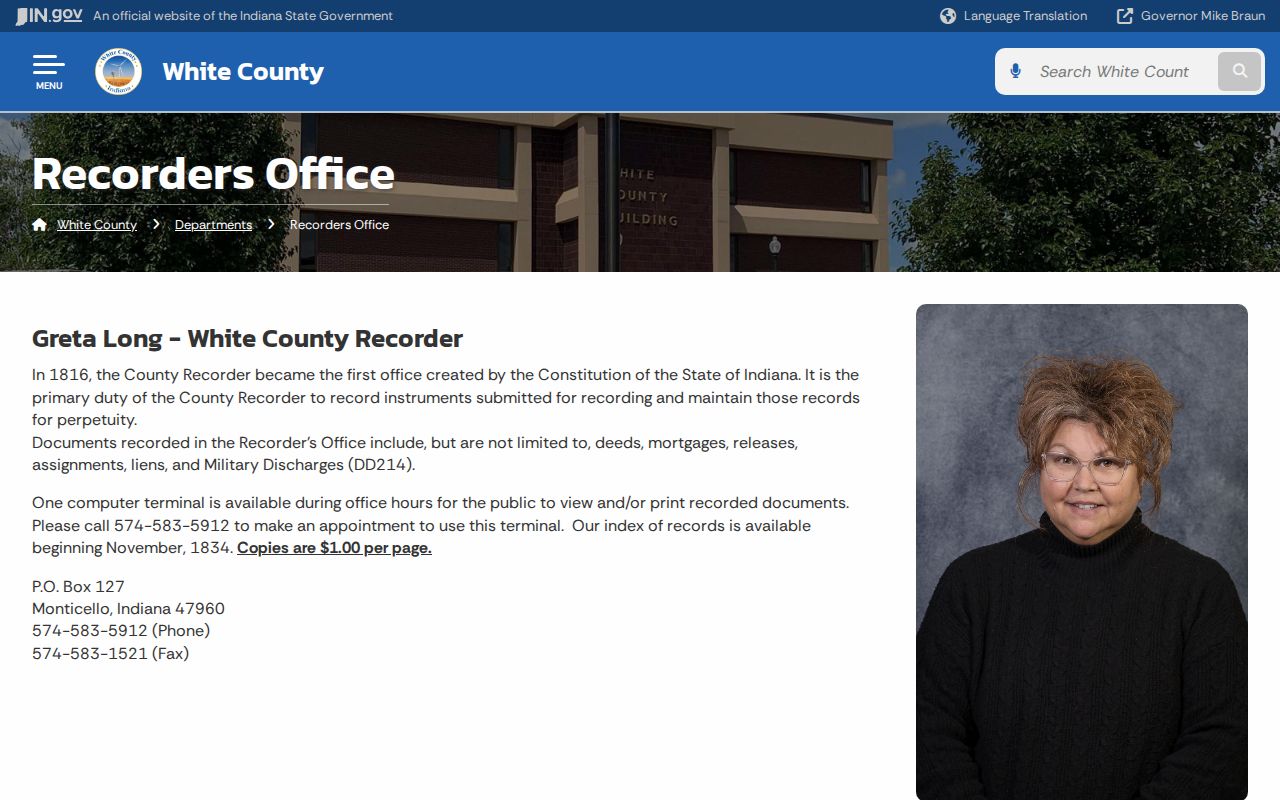
The office page maps out what the recorder covers. The deed images themselves hold the former-owner evidence. Save each instrument in a research log by date and reference.
Walk the White County Deed Chain Backward
Laredo lets you search by name, date range, document type, document number, or legal description. Take the deed chain one step at a time. Each link in the chain should be verified before you move to the next, which works far better than gathering every deed under one surname and hoping the pieces fit.
- Identify the current parcel and newest matching deed; record grantee, grantor, instrument, date, and description.
- Use that grantor as the next grantee search, looking for the instrument by which the grantor acquired the land.
- Confirm the description before accepting the link; street address alone is weak historical evidence.
- Repeat through initials, spouses, trusts, companies, or estates when the ownership form changes.
- At the beginning of county coverage, consult the early books and predecessor-jurisdiction context.
- Grantor
- The party conveying the interest described by the instrument.
- Grantee
- The party receiving that described interest.
- Chain of title
- The ordered sequence of instruments connecting ownership over time.
- Reverse index
- An index route organized to locate parties in the role needed for backward research.
- Quitclaim and warranty deed
- Different deed forms whose legal consequences must be read from the instrument and law.
Open Deed Record Books A and B for 1834–1839
The Indiana State Library White County guide lists Deed Record Books A & B. These cover 1834–1839. The call number is ISLG 977.201 W589d. That finding aid anchors the earliest era of White County deed books. It also helps when a portal's index or image path proves awkward.
Old deeds rarely match a modern street address. Expect section, township, and range language instead, or simple lot-and-block references. Copy names, dates, acreage phrasing, adjoining owners, and book and page numbers exactly as written. Never convert an old description into a current parcel. Check plats, later deeds, and the present map first.
The State Library guide reaches beyond deeds. It points to White County maps, county histories, newspapers on microfilm, and marriage indexes. It also lists original wills and estate papers. These collections help separate people who share a surname. They also explain a name that changed between instruments. Keep each finding tied to its citation. Then confirm the ownership step in the deed book itself. A marriage index or will can guide the search. It cannot prove that person held the tract.
Bridge Estate and Family Transfers
A tidy grantor-to-grantee sequence can look like it ends when an owner dies. The same happens when land moves through an estate, a trust, or a personal representative. Search the decedent's name in Recorder instruments. Also check probate material held by the White County Clerk. Look for deeds, affidavits, transfer-on-death deeds, and personal-representative conveyances. Verify the actual instrument rather than guessing which procedure applied.
The White County Historical Society holds probate and estate files. It also keeps guardianship books and former courthouse materials. The State Library guide lists original wills and estate papers too. These sources can explain a transition or pin down a name. Still, the recorded land evidence should confirm it. The same legal description must have passed to the next owner.
Follow the Legal Description Through Address Changes
Addresses shift over time. Street names change, municipal labels change, and annexation, parcel splits, and combinations all separate a former owner's deed from a current address search. Compare subdivision and lot numbers, section/township/range language, metes-and-bounds text, and recorded plats. The Recorder and Auditor hold plat and transfer material. Beacon offers visual orientation only.
A parcel polygon is not a historical boundary survey. When a description changes between deeds, find out why. An exception, replat, split, combination, or partial conveyance often explains the difference. Never force two descriptions into one chain just because the owner names happen to match.
Add White County House-History Context
For context beyond the deed chain, the White County Historical Society keeps a non-circulating library. The library has real research value. Its shelves hold mortgage books, probate and estate volumes, obituaries, and newspapers. County histories, maps, cemetery records, and surname files sit there too. Staff will research by mail or email for $35 per hour plus copies and postage. These materials put people and places around the names. Your White County property records already establish them.
The State Library guide points to county microfilm, newspapers, city directories, histories, and maps. It also covers WPA indexes and original estate material. A directory listing proves residency, not title. An obituary works the same way. Both help you tell two people apart. They also pin down when a family occupied the house. The deed and the legal description still decide ownership. Every tentative name should return there before it enters your ownership timeline.
Split your research notes into two columns. Put ownership evidence, like a recorded deed, on one side. Put contextual evidence, like a directory entry or obituary, on the other. Cemetery references, newspaper items, and surname files go there too. A White County house history stays honest that way. Residence, kinship, and press mentions never become ownership claims without a recorded link.
Access Older White County Ownership Sources
Laredo works through an account. The Recorder also offers one public terminal, available by appointment during office hours. Call 574-583-5912 to arrange a time. Phone, email, and in-person requests help when an image is missing from the system. Recorded copies cost $1 per page, according to the office's fee list. Give the exact party names. Include the instrument or book and page, the legal description, and a bounded date range.
Indiana's Access to Public Records Act opens a request channel for non-indexed administrative records. Exemptions apply. The Historical Society offers paid research into older books and local newspapers. The State Library's guide and microfilm holdings cover the same ground. No full plat-book index or microfilm-reel list exists. No documented courthouse-loss event appears in the record. Ask the custodian what survives and where it is held rather than assuming a gap.
A strong Recorder request names grantor and grantee variants. It also names a bounded date range, the document type, and a legal-description phrase. Add the current parcel ID only as a cross-reference. An older book may not use it. Request the instrument number or book and page, image availability, and a fee estimate. That approach yields a reproducible chain step, not an unsupported list of people tied to the property.
How Far Back White County Ownership Records Go
The documented deed trail at the White County Recorder begins in November 1834, near the county's creation from Carroll County. Deed Books A and B, covering 1834 through 1839, appear in the State Library finding aid. Searching earlier than the county's own records may call for predecessor-jurisdiction materials or federal and state land sources, though no specific original-patent endpoint is published for individual parcels.
Time-depth limit. November 1834 is the stated start of White County's Recorder index and images, not proof that every chain is effortless or complete. Use former-owner research for house history, estate work, or property diligence, never to track or harass a living person.