
White County Property Tax Fields
In White County, property tax records live in three offices. The Assessor keeps the assessment card, which lists parcel traits and value components. The Auditor records transfers, handles deductions, and manages tax administration forms. The Treasurer collects payments and publishes the tax-account search. Check each field against its tax or assessment year.
Values can shift from one year to the next. A parcel number stays the same, though. Match the year to the document you are reading before comparing figures.
| Field | What it shows | Official source |
|---|---|---|
| Land assessment | Assessed land component | Assessor card |
| Improvement assessment | Assessed building or improvement component | Assessor card |
| Total assessed value | Starting value for tax calculation | Assessor card and Form 11 |
| Deductions | Codes or relief affecting the taxable result | Auditor and tax record |
| Tax district and year | Jurisdiction and billing period | Treasurer list or bill |
| Bill, payment, balance | Amounts charged, paid, or still due when shown | Treasurer account |
A tax bill is not a market appraisal. A taxpayer name is not a deed. Keep each figure in its own column.
The Beacon property card adds class, acreage, physical traits, sales history, legal description, and map access. Those fields can explain an assessment or expose an objective error. Labels and depth vary on the live display, so copy the current White County result exactly when it matters.
Search White County Tax Records
The White County tax list offers five search fields. The page itself warns against entering too much. Search one strong fact first, then add another term only when the list runs long.
| Search field | Type | Required | Local note |
|---|---|---|---|
| Dist# | Text | Optional | Use a known tax district |
| Parcel # | Text | Optional | Copy all punctuation |
| Name | Text | Optional | Use last name |
| Tax Year | Dropdown | Optional | Options vary with the live list |
| Property Address | Text | Optional | City may be included |
Result rows show district, parcel, an extra numeric identifier, taxpayer name, and property address. The display carries a "Not for Official Use" warning. Rely only on an official Treasurer statement.
Rows run 1 through 100 of a 24,529 total. The "Last Updated" stamp is a portal timestamp, not an assessment date for each parcel. Keep the stamp, the tax year, and your access date separate, and note that the portal does not state how far back its accounts reach.
Look Up a White County Tax Bill
Pin the parcel and tax year first. Hold both constant as you move between the assessment card, the bill, and the Recorder's historical coverage date. Save your access date separately.
- Find the parcel or tax ID through Beacon or a prior statement.
- Search the Treasurer by parcel and select the tax year.
- Compare the taxpayer string, property address, district, and any opened bill fields.
- Check the Assessor card for land, improvement, total assessment, and assessment year.
- Ask the Auditor about current deduction filings or a parcel change.
- Request an official statement or receipt when the online notice is not sufficient.
- Assessed value
- The land and improvement value used as the tax starting point.
- Market value-in-use
- Indiana's assessment standard, which is not a guaranteed sale price.
- Levy
- The tax charge produced through the applicable local budget and rate process.
- Homestead deduction
- A deduction administered through the Auditor under current eligibility rules.
- Tax lien
- A claim arising from unpaid tax, which requires official status and title review.
White County Split-Parcel Tax Search
The Treasurer warns that land split or combined in the past two years may need a last-name search to surface every bill. That warning is the page's best insider advice. A parcel number alone can miss a linked account. Search the surname instead. Inspect every matching property address, and retain both the old and new identifiers.
Then compare legal descriptions and transfer records through the Auditor or Recorder. Never merge accounts just because the name matches. Each match deserves its own review. Joint names, estates, and fractional strings like "Und 1/2 Int" can appear in tax results.
Note: Search by surname after a recent split or combination, then verify each result against its address, district, parcel, and tax year.
White County Assessment Standard
Indiana assesses at a 100 percent target ratio. Market value-in-use is the guiding standard. The ratio study divides assessed value by sale price. That does not make every White County assessment equal a later sale price. Transaction conditions, annual trending, parcel traits, deductions, and record dates can all push the numbers apart. Trending adjusts assessment information every year. State rules also follow a four-year cyclical reassessment framework. Form 11 is the notice of assessment. January 1 is the assessment date identified in DLGF guidance, so compare those dates with the deed and tax year before calling a difference an error.
The property-value record covers the fuller split among assessment, taxable value, and recorded consideration. This tax page stays with the bill and appeal. The Treasurer shares an approximate countywide allocation: school 67 percent, county 19, town 9, library 3, township 1.5, and state 0.5. That split is explanatory, not a parcel formula. The actual bill depends on district, rates, deductions, caps, and charges.
White County Deduction Codes
The Treasurer page shows deduction abbreviations. A stands for over age 65. B and V flag veteran categories as displayed, while D, G, H, M, and N mark disabled, government, homestead, mortgage, and non-taxable. W, X, Y, and Z label listed real, personal, residence-related, or rehabilitation categories. The codes are a screen clue. They are not an eligibility guide.
Deductions are filed with the Auditor, and the Treasurer page directs homestead filing there. Ask the Auditor for the current application, eligibility rule, filing date, and required proof. An omitted or incorrect deduction can also serve as an objective issue on part two of Form 130. Never infer personal status from a single letter. Confirm what the live White County account shows and whether the deduction applies to the year under review.
Pay White County Property Tax
The Treasurer offers several ways to pay a White County property tax bill. Options include the county website, mail, a drop box, phone, in-person service, escrow, and participating local banks. Phone payments need the duplicate number. Mailed receipts require a self-addressed stamped envelope. Always verify the account and year before paying. That check matters most after a parcel split or combine. The White County Treasurer page is the official source for payment methods and deductions. It also covers tax-sale information and changing fees.
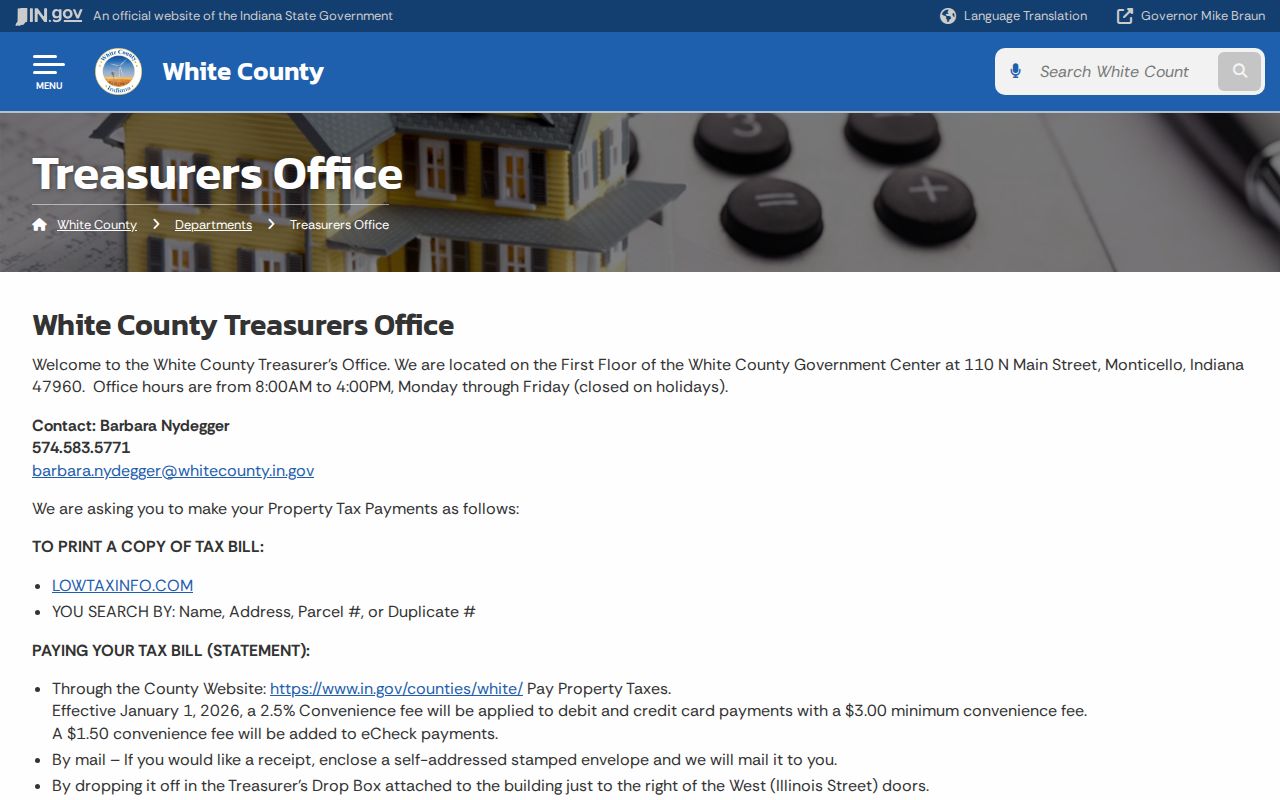
The online tax list is not a certified statement. Card payments carry a 2.5 percent convenience fee with a $3 minimum. An eCheck costs $1.50. Those rates took effect January 1, 2026, and can change, so confirm current charges with the Treasurer before paying.
White County Tax-Sale Records
White County holds one tax sale in the fall. A list can be purchased from the Auditor in late summer. The Treasurer publishes no current sale date, list price, minimum bid, or redemption terms. Those details come only from the current county notice.
A delinquent account or tax-sale list does not prove clear title. Check the Treasurer and Auditor status, notice and redemption records, the later Recorder deed, and any MyCase litigation. Each stage answers a different question.
The Auditor also lists a $10 per parcel plat-book or transfer fee for each conveyance. A sales-disclosure fee runs $20, with stated transfer-fee exclusions. These figures cover transfer administration, not tax-sale purchase terms.
Appeal a White County Assessment
A current-year Indiana assessment appeal starts with Form 130. It goes to the local assessing official. Page one handles subjective valuation. Page two covers objective issues, such as the wrong person, an omitted deduction, clerical or math errors, a wrong physical description, or a legal question. An informal conference and assessor recommendation come first. Unresolved cases move to PTABOA, then the Indiana Board of Tax Review, and potentially Tax Court. DLGF's official appeal page provides Form 130 and the local-first process.
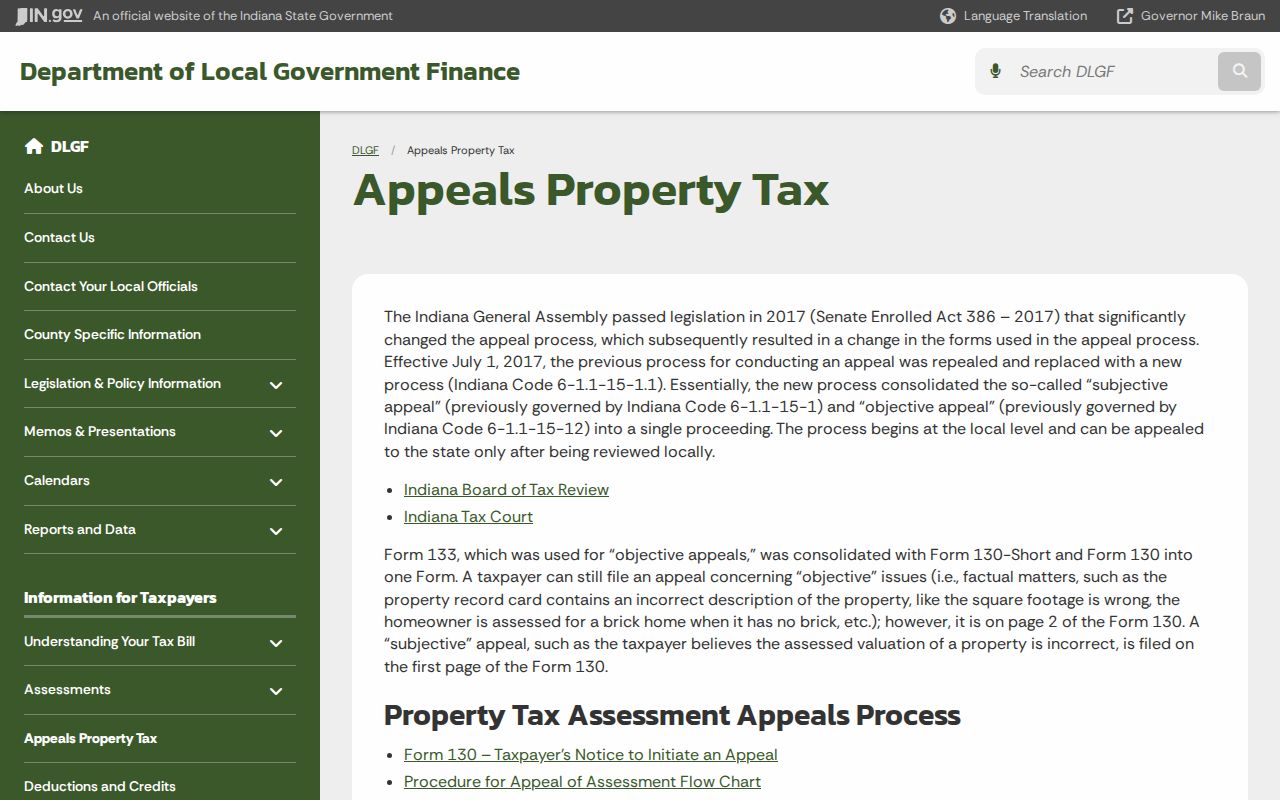
Local filing mechanics still apply. The Assessor can confirm the current White County notice date for any parcel.
Check the notice date. The general deadline is June 15 under the DLGF timing rules, but the applicable year depends on when Form 11 or tax statements were mailed.
Keep Form 11, the parcel card, tax bill, photos, correction proof, comparable sales, and every decision in one file. An appraisal can help. It is not mandatory under the cited state guidance.
Build the file around the kind of disagreement. For a valuation dispute, name the assessment year. Explain why the listed land, improvements, or total fails to reflect market value-in-use. For an objective error, mark the wrong person, physical description, arithmetic, or deduction. Attach the record showing the correction. Keep proof of filing and notes from the informal conference, because the assessor's recommendation and any PTABOA review are separate steps.
The Assessor does not publish one Form 11 mailing date for every parcel. Confirm yours before applying the general June 15 rule. DLGF ties the applicable year to whether Form 11 was mailed before May 1, after April 30, or not at all. A tax-list timestamp will not work. Neither will a payment date or deed recording date. The notice date alone sets the appeal deadline.