
Find Out Who Owns a White County Property
The fastest official path runs through the county-linked Beacon platform and the White County Recorder. Begin with the address when the property is known. Carrying the parcel, not a similar name, through the search keeps results reliable.
- Search the situs address in Beacon and open the matching White County parcel card.
- Copy the owner string, mailing address, parcel/tax IDs, and legal description exactly.
- Search the Recorder's Laredo index for the newest conveyance affecting that description.
- Compare the deed's grantee with the assessor owner field and note each record's date.
- If the grantee is a company, search the official Indiana INBiz business database for the entity record.
Trace a White County Address to One Parcel
Start with a house number and street name, normalizing abbreviations if the full address fails. A mailing city proves little here. White County mixes rural and municipal addresses. Those do not always respect town lines. Beacon also supports owner, parcel ID, and tax ID searches. Save every identifier the system shows. Two county offices may format the same key differently.
Splits and combinations complicate things. The Treasurer suggests searching by last name. That can surface every bill. That clue can show whether one address now maps to several successor tax parcels. It does not settle ownership by itself. Weigh those results against Beacon and the legal description on the deed.
Record both numbers when Beacon shows a parcel ID and a tax ID. The Treasurer takes property address, district, and tax-year queries too. Its output is a tax-administration record rather than a title document. Compare all addresses returned. Carry predecessor and successor parcel numbers into the Recorder search. Do not assume a mismatch means an ownership change.
Where White County Property Owner Information Appears
Every source names a party for its own administrative reason. Agreement across sources is a strong sign, yet the newest deed still wins when proof of ownership matters.
| Where Ownership Is Shown | What It Gives | How Current |
|---|---|---|
| Beacon assessor card | Owner/current owner, mailing and situs addresses, parcel IDs, legal description | Administrative roll snapshot; no published White County refresh interval |
| Recorder Laredo entry and image | Grantor, grantee, recording date, instrument number, legal description | Use the latest recorded conveyance for a recent legal event |
| Treasurer tax list | Taxpayer/name, address, district, parcel, tax year | Tax administration, not proof of title |
| INBiz | Official state business-entity record | Useful when the recorded owner is an LLC or corporation |
An owner of record can live far away, get mail elsewhere, or hold land through an entity. None of these records reliably names the occupant. Situs is the land itself; mailing is where notices go.
Identify the Owner Through the Latest White County Deed
The White County Recorder indexes deeds and other recorded land instruments through Laredo. Search by owner string and legal description, then sort likely conveyances by recording date. Read the image itself. The index row alone cannot show whether the grantee, property description, and instrument type actually match your parcel.
Index and images reach back to November 1834, a depth that serves prior-owner research well. A current ownership check needs only the newest relevant conveyance. The official Recorder page documents the county's access routes. Review the live Recorder page for current details.
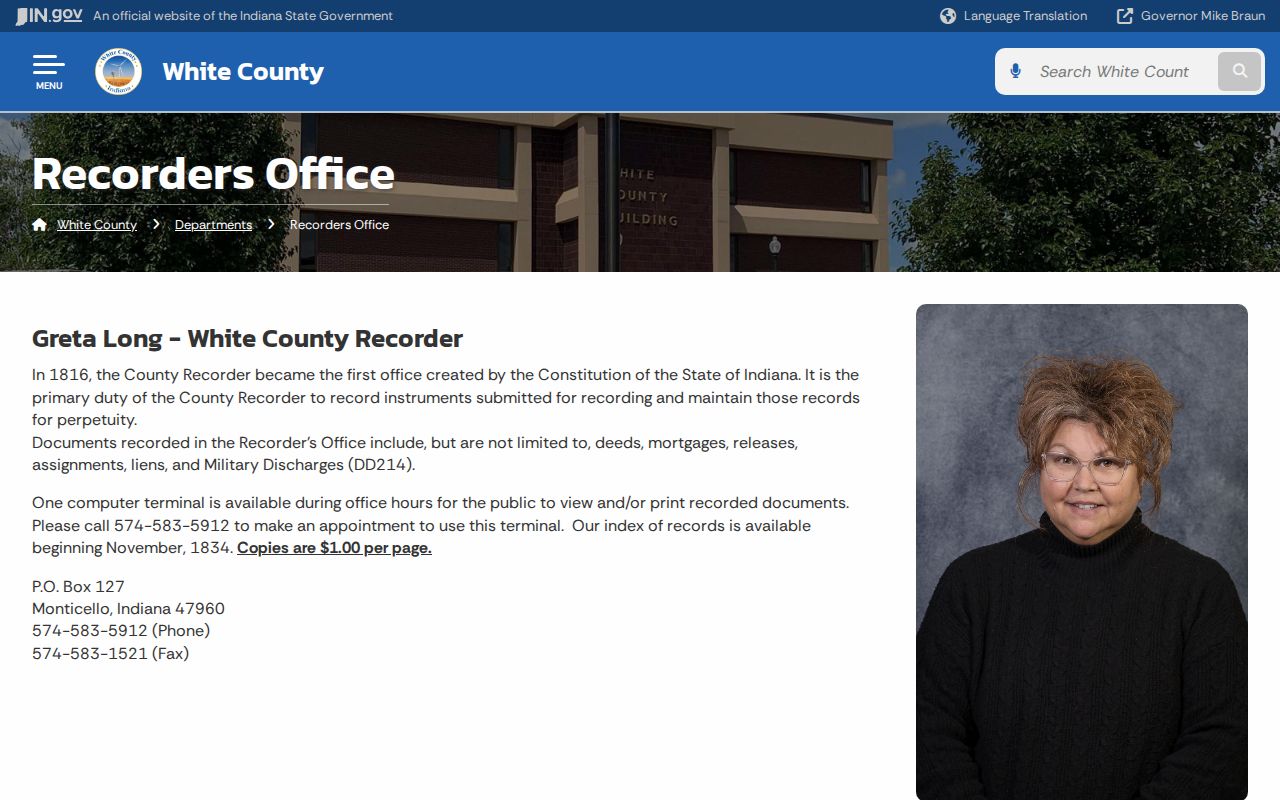
A screenshot is a doorway to the custodian, never an ownership result. Match the newest deed image to the parcel's legal description. Do this before treating its grantee as the recorded owner.
Laredo searches by party name, recorded-date range, document type, document number, and legal description. A common surname can return a crowd of hits. Narrow the dates. Confirm the land description rather than grabbing the newest name match. Access is account-based, and the Recorder also offers one public terminal by appointment.
Recognize Trust, Estate, and LLC Owner Names
Trusts, estates, LLCs, and lists of individuals appear in Beacon. They also show up in county tax rolls as owner strings. White County samples even carry multiple names with fractional-interest wording. Copy the string exactly as written. Search the Recorder for the entity and for the people who signed its instruments. A person can sign in a representative capacity without owning the land individually.
For an LLC or corporation, INBiz helps locate the official entity record. A registered agent is not automatically the property owner. For an estate, set Recorder instruments beside probate material held by the White County Clerk. A deceased owner's name can linger on an administrative roll. It stays there until a conveyance is recorded and county property records catch up.
Keep the trustee or representative wording from the deed. Do not shrink it to a personal name. These checks show who appears in public records. They do not expose every beneficial interest or amount to a title opinion. Where an instrument's effect is unclear, preserve its exact language and get qualified legal interpretation.
Handle a Recent White County Closing Carefully
White County publishes no standard lag between closing and assessor update. It also states no set roll-refresh interval. Do not estimate one. When Beacon and a new deed disagree, compare dates. Treat the recorded deed as the newer legal evidence, and recheck the assessment roll later. A purchase contract or closing statement cannot substitute for confirming that the conveyance was actually recorded.
Keep notes or screenshots of when each record was consulted. The owner field, deed recording date, instrument number, and legal description make the difference explainable. Together they let you explain the gap without inventing a schedule the county never stated.
Reach White County Ownership Records Offline
Beacon is not the only way in. If it stalls, reach the White County Assessor by phone, email, or an office visit. Request the property record card for the parcel. For recorded documents, Laredo runs on accounts. The White County Recorder also keeps one public terminal, available by appointment during office hours. Staff will help by phone or in person. Copies cost $1 per page.
Give the office something to work with. A parcel ID, a party name, a legal description, or an approximate recording date is usually enough. That will pull the right deed record. Indiana's Access to Public Records Act offers another route for administrative records that are not indexed online. It comes with statutory exceptions, though. It also never obliges a custodian to decide ownership or build a title analysis. For tracing older owners, the Historical Society and the State Library hold real value. They simply are not the first stop when the question is who owns a property in White County today.
Whatever channel you use, bring precision. Supply the situs address, the exact parcel and tax IDs, and the legal description if you have it. Add the party name exactly as recorded and the rough date of the record. Say what you need, too: an assessment card, an index entry, a deed image, a tax account, or a plat. Pick one. That specificity lands the request with the correct custodian. It also keeps one office from being asked to interpret another office's property records.
Read White County Ownership Terms Precisely
- Owner of record
- The party currently named in an official administrative or recorded ownership source; verify which source is meant.
- Grantee
- The party receiving the interest described in a recorded deed.
- Title
- The legal ownership interest, which a simple online owner lookup does not insure or adjudicate.
- Situs address
- The physical location of the parcel.
- Mailing address
- The destination for notices; it may be outside White County and does not move the parcel.
What a White County Ownership Lookup Cannot Tell You
A public owner field has limits. It does not prove who occupies the property. It does not guarantee marketable title, expose every beneficial interest behind a trust, or confirm that each recorded lien has been released. Protected-address and confidential-record rules apply as well. Indiana's Safe at Home program gives qualified participants a substitute address, so never try to rebuild a protected location from other property records.
Owner name is not title proof. Use ownership records for legitimate property research, purchase diligence, estate work, or fraud prevention. Never use public information to stalk, harass, intimidate, or defeat an address-confidentiality protection.
Public sources sometimes disagree. When they do, keep a short source log. Don't pick whichever owner name looks easiest. Log the Beacon access date, the parcel ID, the tax-list year, and the Recorder instrument number. Record each owner name in its exact recorded spelling. A harmless spelling change is one thing. A different grantee, legal description, or parcel identifier is a red flag. It calls for a closer look at the deed records.
Each office has its lane. The White County Recorder can help you locate the indexed instrument. The Assessor can explain the assessment card. Neither should be asked for a legal opinion. For a purchase, an estate, or a disputed interest, get expert help. Hand the collected records to an Indiana attorney or title professional. They are the ones who can evaluate the full chain of ownership.