
White County Deed Record Types
The White County Recorder records and preserves instruments that affect land. Deeds are a core class in that index. Each deed reflects a submitted conveyance. Match any deed you find to its legal description before relying on it.
| Deed type | What it does | Common record use |
|---|---|---|
| Warranty deed | Conveys the stated interest with warranties written in the instrument | Ordinary land transfer |
| Quitclaim deed | Conveys the grantor's stated interest without the same warranty form | Family, correction, or source-of-title transfer |
| Transfer-on-death deed | Provides for a later transfer under its recorded terms | Estate planning |
| Personal-representative deed | Conveys through estate authority | Probate-related land transfer |
| Sheriff or tax-sale deed | Records a transfer from the stated sale process | Foreclosure or tax-sale trail |
Mortgages, assignments, releases, and liens are indexed beside deeds. They are not conveyances of the same kind. Check their dates and legal descriptions before treating any filing as current.
A deed may connect to a Sales Disclosure Form. This happens when real property moves for valuable consideration. Indiana's public search covers records from July 1, 2008 forward. But DLGF warns that county submissions can be missing. The form adds context, but it is not the deed. Nominal consideration is not always the sale price.
White County Laredo Since 1834
The Recorder's land index begins in November 1834. Laredo images run from that month to the present. That span reaches the county's founding era, not merely modern scans. Laredo is account based and works around the clock. Tapestry is also linked, but the county page leaves its complete pricing and field rules unstated. The White County Recorder access page is the stable source for search modes, coverage, the terminal, and copy service.
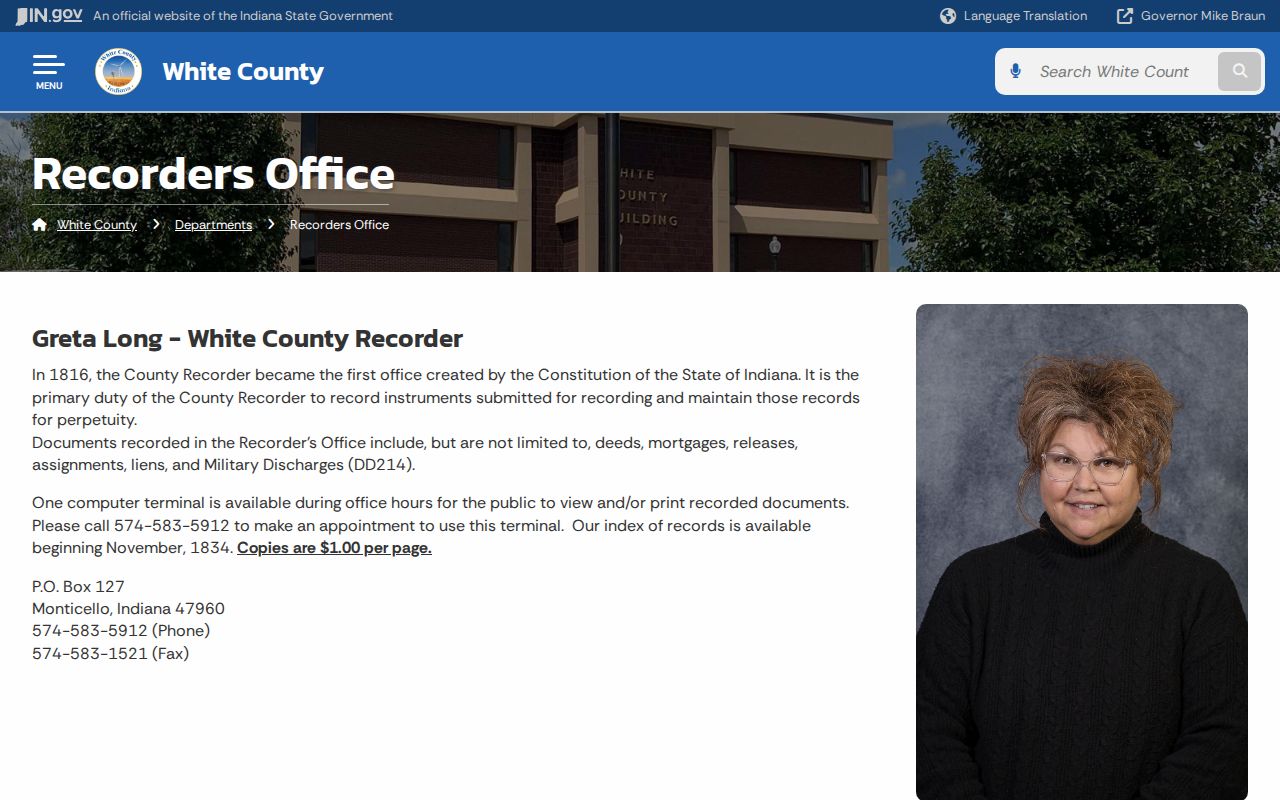
The Recorder access page gives the county-backed entry point. Result URLs can change during an account session. The 1834 starting point is not a later imaging cutover, since the county expressly describes the index and images from November 1834. If an early party seems missing, test initials, spouses, former surnames, entity names, and legal-description words. Only then decide no deed exists.
Search White County Deed Fields
White County verifies five direct search paths in Laredo. Field requirements, result caps, and the full document list appear only in the live controls. Use the search options as displayed there.
| Field | Type | Required | Use |
|---|---|---|---|
| Name or party | Text | Not stated | Search grantor and grantee forms |
| Recorded dates | Date pair | Not stated | Narrow common names |
| Document type | Selector | Not stated | Separate deeds from mortgages, releases, assignments, or liens |
| Document number | Text | Not stated | Pull a known instrument |
| Legal description | Text | Not stated | Match land when the address fails |
Results can be grouped and ordered. Image viewing works from the same session. Search the person plus any trust, estate, or LLC named on the assessment card. Compare the legal description, not just the name.
For each hit, save the role, instrument number, recording date, type, book and page, legal-description excerpt, parcel reference, and image status. Branch the worksheet when several people convey the land. An estate transfer may need separate notes for the decedent, the representative, the grantee, and the probate file.
Walk White County Grantor-Grantee Records
A grantor conveys the stated interest. A grantee receives it. The chain of title is the linked sequence of transfers affecting the same land, so begin with the newest relevant deed rather than the oldest name a family remembers.
- Copy the current parcel's owner clue and legal description from Beacon.
- Find the deed in which that party appears as grantee.
- Read the image and save grantor, grantee, date, instrument, and legal description.
- Search that grantor as an earlier grantee.
- Branch the notes when an estate, trust, or several grantors appear.
- Book and page
- A volume-and-page reference for a recorded document.
- Instrument number
- A distinct identifier assigned to a recorded filing.
- Reverse index
- An index route used to find a transfer by the opposite party role.
- Legal description
- The land description that ties the filing to the parcel.
Keep each link as its own row. The Assessor owner field helps, but it is not the deed chain.
Name changes create breaks. Search exact spellings, surnames alone, initials, spouses, estate captions, trustees, and entity names. Legal-description phrases keep the land in view while names and streets change, so compare lot and block, section and township, or metes-and-bounds text as written.
White County Deed Books A and B
The Indiana State Library lists Deed Record Books A and B for 1834 through 1839. The call number is ISLG 977.201 W589d. That finding aid anchors the county's first deed years. It helps when an early spelling needs more context. The State Library county guide also points to microfilm, maps, histories, newspapers, wills, and estate papers.
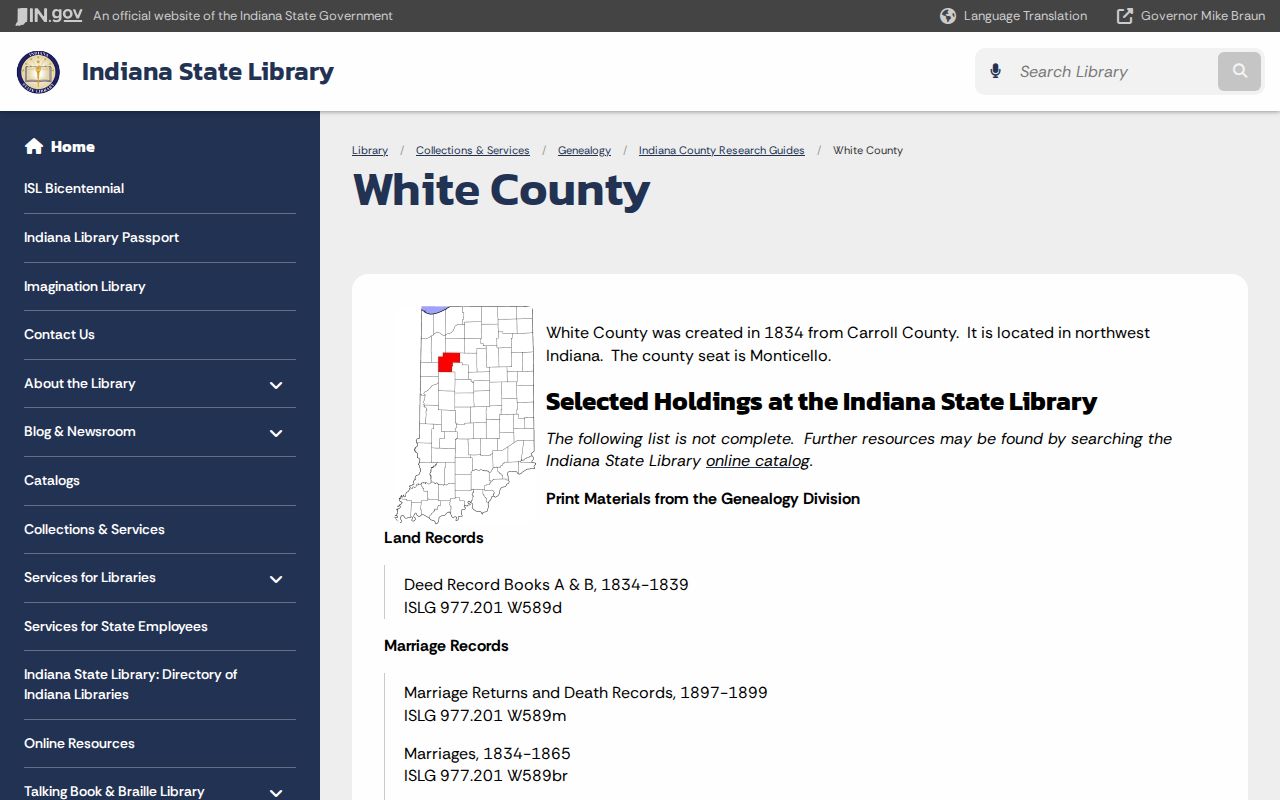
Those resources can trace people and land, yet the recorded deed image still stands as the stronger proof of ownership in White County.
White County Recorder Access Channels
Deed records reach the public in more than one way. Besides online access, White County offers a public computer terminal in the Recorder's office during business hours. It is available by appointment. Reach the office at 574-583-5912. The Recorder's mailing address is P.O. Box 127, Monticello, Indiana 47960, with fax at 574-583-1521, and copies cost $1 per page.
Shape any written request around specifics: party names, a date range, an instrument number when known, the legal description, a parcel reference, and the type of copy wanted. Ask up front whether certification, postage, staff search time, or online delivery alters the price. Indiana APRA lets you ask for an existing record or an index span. It does not cover a built title chain.
Older questions can carry on through the State Library or the White County Historical Society. Remote research through the Society runs $35 per hour plus copies and postage.
Its shelves hold former courthouse books, mortgage books, probate and estate files, guardianship books, obituaries, cemetery records, maps, newspapers, county histories, and surname files. A name change or an earlier reference may surface there. Cite the exact source, then return to the Recorder's instrument for the transfer itself.
White County Mortgage Release Trail
The Recorder's index sorts filings into mortgages, releases, assignments, and liens. A mortgage recorded years ago may have been assigned twice and released once. Tracing that path takes patience. Search both the current owner of record and prior owners. Match the legal description to the parcel. Read the chronology forward before calling any filing open. One early match proves little on its own.
Some encumbrances refuse to stay in one office. A mechanic's lien may live partly in Recorder filings and partly in court litigation. Tax liens and delinquency point toward the Treasurer or Auditor. A tax-list balance is never a complete encumbrance search. A foreclosure case in the courts, likewise, only tells half the story. The later Recorder instrument shows whether a transfer was actually recorded. One category deserves special mention. Military discharges sit among the Recorder's named filing types but carry access limits. A DD214 should never serve as an everyday example of a public deed.
White County Deed Fraud Alerts
White County offers Property Fraud Alert. Users pick Indiana and White County, then receive notice whenever a matching name shows up in a new recording. Think of it as an early-warning service. It is not a ruling that a document is fraudulent, and it is no substitute for title insurance.
An alert is only the first step. Pull the indexed instrument next. Compare the parties, document type, recording date, and legal description against the parcel you know, and if the filing matches nothing you expected, call the Recorder through its official page. The same skepticism applies to deed-copy solicitations. A private mailing may charge far more for a record the county sells. Check any offer against the Recorder's official $1-per-page figure and contact information, and confirm the instrument number and copy type before paying anyone.
Note: An alert can trigger a quick check, but only the underlying instrument shows what was truly submitted and recorded.
Order a White County Deed Copy
An instrument number makes any order simple. Without one, give the grantor and grantee. Add a narrow date range, the parcel or legal description, and the deed type you need. Say whether you want an online image, a plain office copy, or a certified copy. Confirm every charge before sending payment. The published base rate is $1 per page.
Tapestry offers another online route to the same deed records. Its county-selection entry is open to the public. Current terms should be confirmed with the Recorder. If an account or session barrier arises, a terminal appointment can clear it.
Recorded, not guaranteed. White County deed records show instruments accepted for recording. They do not guarantee clear title or resolve every unrecorded interest.
General lookup mechanics live in the White County property search. Deed work begins once you know a party, parcel, instrument number, or legal description.
A request for one existing instrument is easier to verify. A finished title history is harder to check. Hand the Recorder the document number and recording date when you have them. Otherwise supply the grantor and grantee. Give a tight date span, the parcel, and the legal description. Ask the office to check deeds, corrective deeds, affidavits, and sheriff or tax-sale deeds. Also ask about related releases touching the same land.
State up front whether the copy must be certified. Request the page count, delivery method, and postage. Ask about any charge beyond White County's published $1-per-page rate. For an office visit, call 574-583-5912 ahead of time. The single public terminal runs by appointment. That distinction matters. Retrieving a county record is one thing. Asking the Recorder for a legal conclusion about title is another.